- HOME
- About AIS
- Study Abroad Program
- Clare Hall, University of Cambridge Summer Visiting Student Program Report
Clare Hall, University of Cambridge Summer Visiting Student Program Report
2025 Academic Year
Ayuno Kawakami: PhD candidate, Department of Advanced Interdisciplinary Studies, Graduate School of Engineering, The University of Tokyo
Clare Hall
From 12 July to 12 August 2025, I stayed at Clare Hall, University of Cambridge, as a visiting student from RCAST. During this period, I had the invaluable opportunity to meet and learn from distinguished professors, researchers, and many diverse and fascinating individuals whom I might otherwise never have encountered. The experience was both academically enriching and personally inspiring, enabling me to build meaningful connections and to broaden my perspectives.
Academic Visits at Cambridge
Since my visit coincided with the university’s summer vacation, arranging appointments with professors and researchers at Cambridge proved challenging. Nevertheless, I was fortunate to have the opportunity to meet with two professors and one Japanese NHS doctor. My first meeting was with Professor Rita Horvath, whose laboratory is based at the Cambridge Biomedical Campus, south of the city centre and widely recognized as Europe’s leading hub for medical research. Professor Horvath’s work focuses on uncovering the critical molecular mechanisms underlying rare inherited neurological disorders, with the ultimate aim of developing effective treatments. I subsequently met Dr Brigitte Steger at the Faculty of Asian and Middle Eastern Studies on the Sidgwick Site. Dr Steger teaches courses on Japanese society, intercultural communication, and qualitative research methods. Although the number of students specializing in Japanese Studies at Cambridge is relatively small, gaining insight into how Japanese language and culture are studied outside Japan was thought-provoking and prompted deeper reflection. I am also eager to further develop my understanding of the perspectives from which international scholars analyze and interpret Japan.
Finally, I had the privilege of meeting Dr Shoko Hirosue, who obtained an MB/PhD from the University of Cambridge and now works as an NHS doctor. Dr Hirosue explained in detail the emphasis placed on medical training at Cambridge, particularly its focus on developing communication skills with patients, as well as the differences between Japanese healthcare and the NHS. Through our discussion, I gained a deeper understanding of the contrasts between medical systems in Japan and the UK, and of the abilities and roles expected of doctors in the UK. The insights I gained from these three individuals were invaluable and will undoubtedly inform my future research.
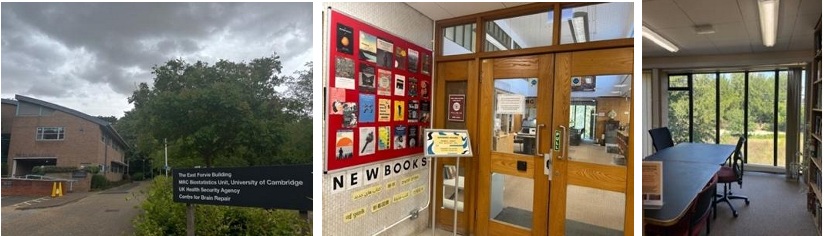
Figure 1. From the left: John Van Geest Cambridge Centre for Brain Repair; Faculty of Asian and Middle Eastern Studies Library.
International Summer Programme
I participated in Week 4 of the International Summer Programme from 3 to 8 August. On the first day, I joined a city tour with other participants, during which I was introduced to the history of both the University of Cambridge and the city itself. Motivated by a desire to improve my English writing for future academic work, I enrolled in Writing Non-Fiction: Lives, Past and Present, taught by Mr. Derek Niemann.
My classmates came from a wide range of national backgrounds, and I was the only Japanese student in the class. They represented Australia, China, India, Ireland, Malaysia, Singapore, the United Kingdom, and the United States. All were remarkable women of different ages, bringing with them diverse careers and educational experiences. Many were native English speakers, and each produced original, distinctive, and high-quality work on a daily basis. In this way, I was able to engage with a standard of writing that I could not have experienced in Japan.
Equally striking was the supportive and considerate nature of my classmates, which created an atmosphere that was consistently warm and encouraging. The course itself not only introduced us to notable works of non-fiction but also carefully explained the fundamentals of the genre, making the five days pass remarkably quickly. Although I sometimes felt inadequate when comparing my own writing to the high standard of my classmates’ work, the experience emphasized the importance of developing the ability to express my ideas in English and of cultivating greater awareness of the structural and stylistic differences between English and Japanese writing. Beyond the classroom, recognizing that I might never again have the chance to engage with such talented and international classmates, I actively sought opportunities to spend time with them. Together we engaged in conversations at cafés, pubs, and restaurants, and even enjoyed punting on the River Cam, creating memorable experiences that enriched both my academic and personal life. I feel truly fortunate to remain connected with my classmates from this course through our online group, which has allowed us to maintain our ties even after the classes concluded.
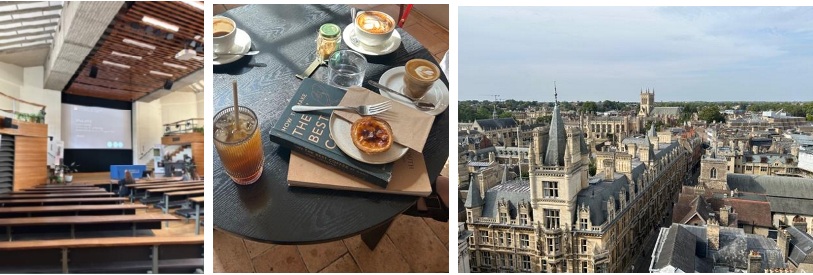
Figure 2. From the left: International Summer Programme orientation; a local café; views of the city.
Exploring Colleges of Cambridge
As it was the summer vacation, only a small number of master’s and PhD students were in residence at Clare Hall. Fortunately, I received the generous support of a master’s student who soon became a close friend. She not only guided me through Clare Hall but also introduced me to other colleges, university facilities, and dining halls. Together, we visited nearby colleges, shared meals, and explored the city, creating many memorable experiences in a short time. Without her kindness and openness, I would not have had such rich opportunities to become acquainted with the wider University of Cambridge. Through these experiences, I also discovered favorite places for reading and writing, as well as gardens and cafés within the colleges that offered quiet spaces for rest and reflection. The distinctive environment of the Cambridge colleges provided an ideal setting, enabling me to concentrate fully and to complete the academic paper that I had been working on since I was in Japan.
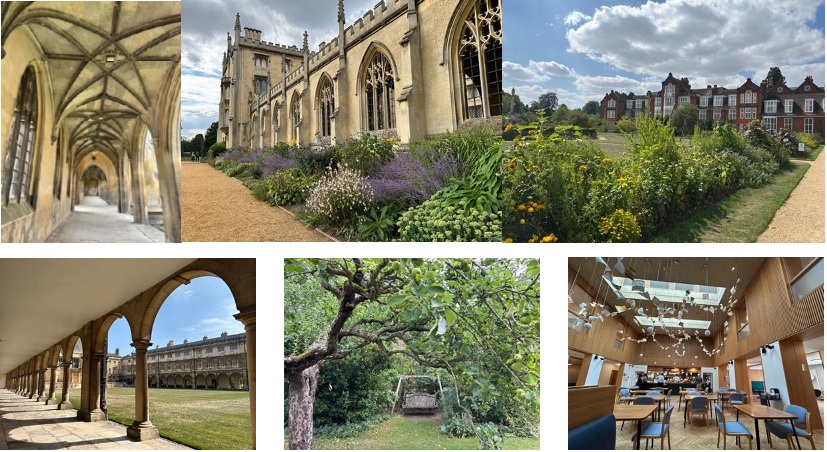
Figure 3. Interiors and gardens of several Cambridge colleges, along with a college café.
One of the aspects that impressed me most, particularly in contrast to the doctoral experience in Japan, was that sharing meals or tea with people one had never previously met is regarded as an integral part of academic life. In Japan, interactions tend to be limited to those within the same research field or to familiar acquaintances. At Cambridge, however, dining at Clare Hall and other colleges frequently created opportunities to meet people from a wide range of academic backgrounds. I therefore made a conscious effort to take my meals in the colleges whenever possible. On several occasions, I had the privilege of dining with distinguished researchers in my field of interest. These encounters, though humbling, were deeply inspiring and left a profound impact on me. During my stay, I came to fully appreciate the importance of social interaction within the university and college setting, as well as the valuable learning that arises from it. I was also deeply influenced by the friendliness and openness of other researchers, my classmates, and the master’s student at Clare Hall who supported me throughout my time there. These experiences encouraged me to engage more actively in conversations with people from diverse backgrounds.
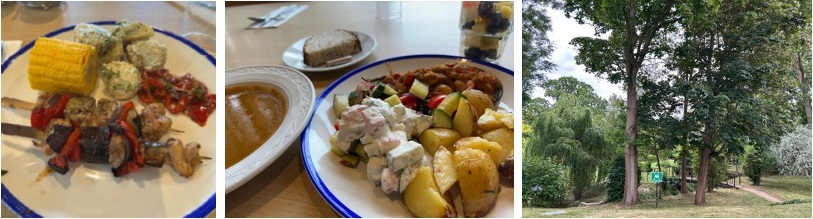
Figure 4. Meals served in the Clare Hall dining hall, and the Clare Hall garden.
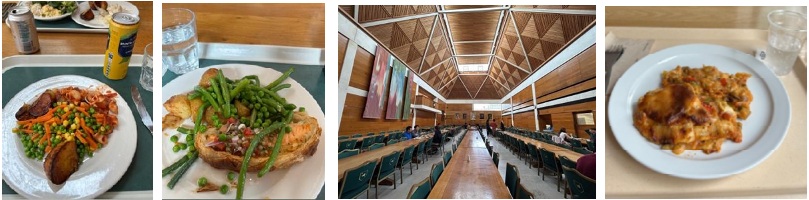
Figure 5. From the left: meals from the Queens’ College dining hall, its interior, and a meal from the Newnham College dining hall.
Another distinctive and memorable aspect of life in Cambridge was the frequency of spontaneous conversations with strangers, something far less common in Japan. For instance, I spoke with someone sitting next to me in a café, exchanged a few words while waiting for a bus, and even initiated a conversation with a fellow passenger who was reading the English translation of a Japanese novel. Through these diverse interactions, I came to realize that I would very much like to return during an academic term in order to experience more fully all that Cambridge has to offer while immersing myself in research.
Lastly, I would like to express my heartfelt gratitude to Dr Holly Hedgeland, Tutor of Clare Hall; to my wonderful classmates and the instructor of the Writing Non-Fiction course, who kindly reached out to support me in times of need, even after the course had ended; and to my warm-hearted friend at Clare Hall, who thoughtfully prepared a gift for me on the day of my departure and waited with me in front of the accommodation until it was time to leave. I am also deeply grateful to all the professors and staff of RCAST who contributed to this program, as well as to the individuals at Cambridge who so generously made time to meet with me despite their demanding schedules.